Celebrating Accessibility: Staff Highlights
Every day, staff across Delta are working to build a more accessible and inclusive community for all residents. We are excited to highlight just some of the staff who are creating a more accessible Delta—read their stories below!
Laura
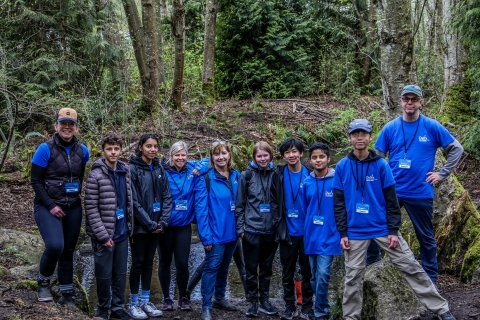
For Laura, accessibility has been at the heart of her career from the very beginning.
“I have a lot of weird skills,” she laughs. “In my early adult years I worked for the North Shore Disability Resource Centre, and I worked as a one-on-one community support worker for children with special needs. I also co-led a recreation program for adults who had brain injuries.”
Following this, along with 10 years with the Delta School District as an Education Assistant and Behavioural Interventionist, Laura stepped away from work to raise her family. Even then, she missed being involved in the community and became a level 3 specialized foster caregiver.
When her children grew older and she was ready to return to full-time work, joining the City of Delta in 2017 felt like a natural fit.
“I really loved working in recreation, and the fact that this job included my history of working with people with disabilities and families… it just came together at the right time.”
Today, as Delta’s Volunteer Coordinator and Programmer for People with Disabilities, Laura wears many hats. She recruits and trains volunteers, supports inclusive programming, coordinates peer support initiatives, and works directly with families whose children need additional support. But while her responsibilities are wide-ranging, the heart of her work is people—and her approach is one that sets Delta apart. Laura notes that many other organizations ask families to fill out a form to identify their needs, she is “the only one that actually sits down with every family”.
By taking the time to understand each child’s individual needs, Laura learns not only what supports are required, but also what families truly want from their experience. For many parents, however, this level of support can feel daunting.
“A lot of families are so used to fighting for their children,” she explains. “It can be disarming to hear that we are their allies, that we want to help.”
That people-first approach has helped Delta support more than 700 families in accessing programs and services in ways that work for them. More than anything, though, it is Laura’s genuine care and commitment that make such a lasting impact.
When asked what guides her work, her answer comes without hesitation:
“Always be curious. Always be humble. I’m always learning, and I’m always adjusting, and I’m just trying to figure things out and make it a better place.”
Michelle
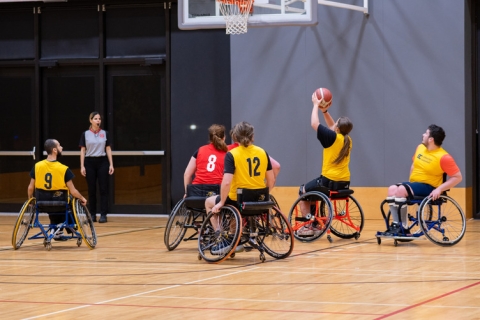
Michelle is helping shape a more inclusive recreation landscape in Delta—one wheelchair basketball game, sensory kit, and community connection at a time. And how she got there? You could say it was kismet.
“In Fall 2024, there was a green light to put more focus on youth and equity, diversity and inclusion,” Michelle explains. “Because I was already working with BC Wheelchair Basketball Society through our gym and sports programming, this program and adaptive programs within Community Recreation became part of a new Youth & EDI portfolio.”
Drawing on years of experience across Parks, Recreation and Culture, Michelle stepped into the role of Recreation Program Coordinator for Youth and Equity, Diversity and Inclusion—a move that simply made sense. While she doesn’t oversee EDI across every department, she has become known as a bridge-builder, connecting people, programs, and ideas to help ensure accessibility and inclusion are embedded into Delta Community Recreation programs not as an add-on, but by design.
One example of that work is wheelchair basketball.
“I was looking to diversify our current basketball drop-in offerings,” she says. Her daughter, then studying Kinesiology at UBC, was helping deliver a Have A Go! session through BC Wheelchair Basketball Society, introducing participants to sport wheelchairs and inclusive recreation opportunities. Curious, Michelle attended and met Nadine Barbison, Director of the Let’s Play program. With Nadine’s support—and funding from a Canadian Tire Jumpstart grant—Michelle and her team built the foundation for what has become a thriving program.
Today, the program brings together players with and without physical disabilities in an inclusive recreational environment. Four regular participants have even advanced to High Performance programs with BC Wheelchair Basketball Society and Wheelchair Basketball Canada.
Along with Wheelchair Basketball, the community recreation team offers additional adaptive programming including Adapted Gym, which provides an inclusive environment for people with disabilities to participate in organized gym activities. Watch for Drop-In Boccia and Para-Hockey Try It sessions to make their debut later this year as well!
Beyond creating camaraderie among players and staff, these programs have also revealed barriers to accessibility that may otherwise go unnoticed.
“There are so many learnings,” Michelle says. “It’s easy to look around and say, ‘we’re accessible,’ but until you put yourself in a chair and try to move around the facility, you don’t realize what barriers exist.”
One lesson that stands out involved automatic door openers installed at a gymnasium. Buttons were placed at both hand and foot level to support accessibility, including for assistance dogs. But Michelle learned that square buttons can injure a dog’s paw; round, dome-shaped buttons are safer.
It’s through the partnerships Michelle has built that these insights come forward, creating opportunties to continually improve accessibility across Delta. And perhaps most importantly, she says, “I have support from Delta to give things time to grow—to try different ideas. As long as it benefits our community, they’re willing to support it.”
Watch some of these programs in action:
Naomi
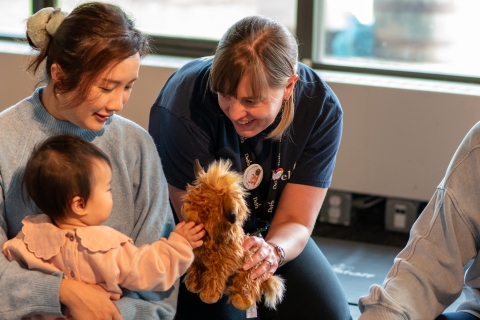
At the Douglas J. Husband Discovery Centre, creating a welcoming experience for everyone is a top priority.
“We’re fully wheelchair accessible: everything has step-free access and all the displays are at wheelchair height. We also offer sensory-friendly sessions and sensory backpacks that visitors can use for free when they come. We want everyone to be able to enjoy the museum experience, whatever their needs might be.”
As the Culture and Heritage Education Coordinator, Naomi oversees educational programming at the Discovery Centre and across Delta. From designing sensory-friendly programming to developing accessible exhibits and resources, inclusion is central to her work—and it’s something she has valued since the beginning of her career.
“I trained in Museum and Gallery Studies, and part of that was learning how to teach the public about interacting with history,” she explains. “That works really well when you’re working with folks with additional needs, because any exhibit you put together should be accessible to all.”
That mindset shapes much of Naomi’s day-to-day work as she creates programs for residents from every corner of Delta. While welcoming visitors into the Discovery Centre is one part of the job, building relationships with community organizations is equally important.
“We reach out to groups like Kyndred, REACH, and the School District, letting them know what we have on offer,” Naomi says. “I’m also hoping to have more of a two-way dialogue—working together to develop what we can put in the galleries and what else we could be offering in our programming.”
Through these partnerships and programs, Naomi has helped position the Discovery Centre as a space that truly belongs to everyone. But making spaces more accessible often comes with challenges.
“The biggest challenges usually come down to funding and capacity,” she says. “A lot of the things that can make for a great visit for someone with accessibility needs can be quite expensive, and you also need time to work with experts on it.”
One experience, in particular, has stayed with her. A young student visiting the Discovery Centre with her elementary school class had no trouble navigating the space itself—but getting there was another story. Renting a bus that could accommodate her mechanical wheelchair would have cost over $1000.
“It’s funding,” Naomi says. “It all comes down to funding.”
Even with those challenges, Naomi’s passion for the work is undeniable.
“I think museums can have such a big impact on any person’s life,” she says. “I strongly believe you can see such incredible impacts from bringing in a kid in and the learning they can do and what opens up for them.”